
What Is Forex Trading and How Does It Work?

The Trading Classroom
Written and reviewed by our editorial team · Updated June 2026

Forex trading is the act of buying one currency while selling another, hoping the exchange rate moves your way. The foreign exchange market handles over $7 trillion per day, making it the largest financial market in the world. It runs 24 hours a day, five days a week, across four main trading sessions.
What you'll learn
 What you'll learn
The Biggest Market You Have Never Seen
Every time someone books a holiday in Tokyo, a factory in China gets paid for a shipment, or a pension fund in Norway buys American shares, currencies get swapped. Add all of those swaps together and you get the foreign exchange market, or forex: over $7 trillion changing hands every single day.
That number is hard to picture, so here is a comparison. The entire New York Stock Exchange trades a few hundred billion dollars on a busy session. Forex clears that before most of Europe has finished breakfast. And yet it has no building, no trading floor and no opening bell.
Forex is a decentralised market, which means it is not run from one exchange. It is a global network of banks, brokers and electronic platforms quoting prices to each other around the clock. When you place a trade in MetaTrader 5, you are plugging into the retail end of that network through your broker.
Who Trades Forex, and Why They Bother
Forex is not mostly retail traders betting on charts. Banks and other large financial institutions do the heavy lifting, trading with each other and handling the currency needs of everyone else. Some of that is plain commercial business: a German carmaker selling vehicles in the United States collects dollars but pays its workers in euros, so someone has to convert.
Central banks show up too, setting interest rates and occasionally stepping in to steady their own currency. Hedge funds and asset managers use forex to protect international investments or to take a view on where a currency is heading. Together, these players set the prices you see on your screen.
Retail traders like you are the smallest slice of that pie, a low single-digit percentage of daily volume. That is not an insult, it is useful information. You are never going to move this market, so your whole job is to read it rather than push it.
A Currency Pair Is Always a Trade Between Two Things
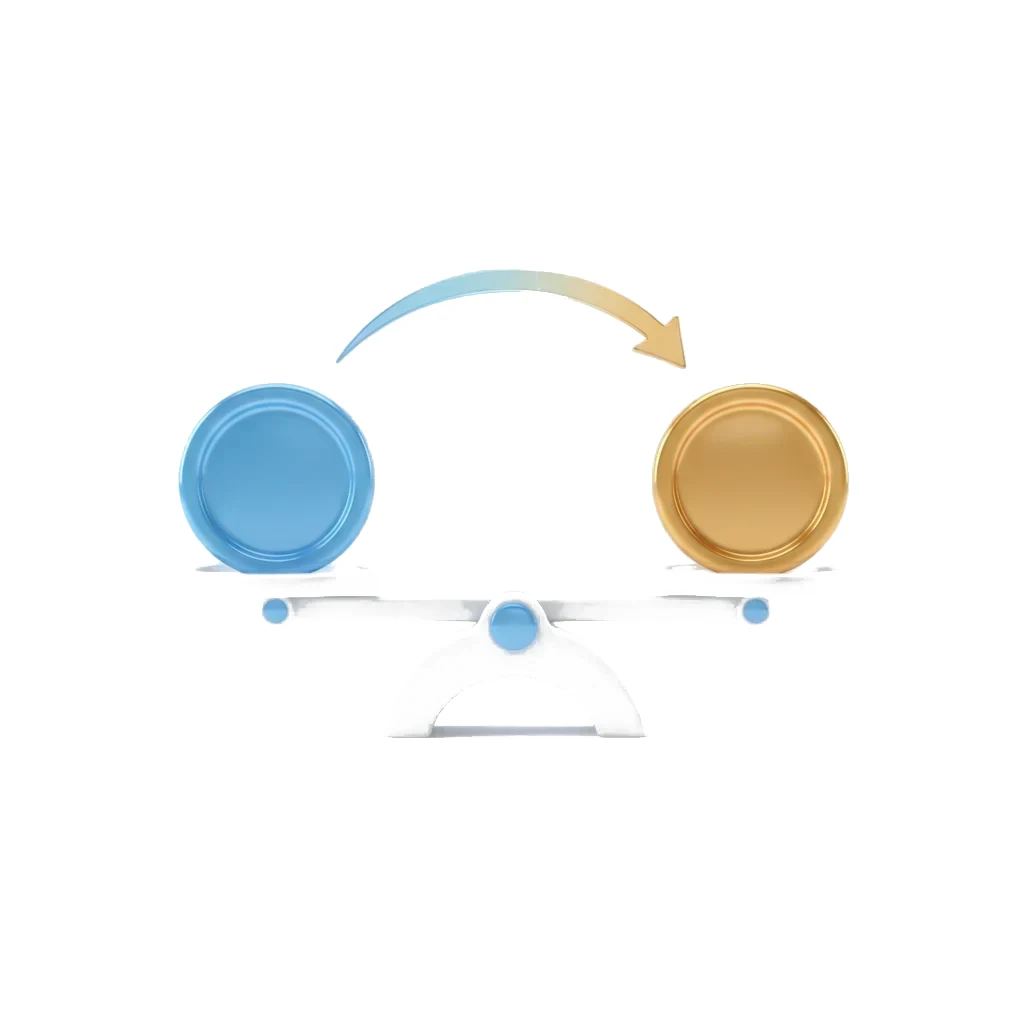
Here is the one idea that unlocks everything else. You never simply buy forex. You always buy one currency and sell another at the same instant. That is why prices are quoted in pairs, like EUR/USD or GBP/JPY.
The first currency is the base currency. The second is the quote currency. The price tells you how many units of the quote currency it takes to buy one unit of the base. If EUR/USD trades at 1.0850, one euro costs 1.0850 US dollars.
So when you click buy on EUR/USD, you are buying euros and paying with dollars. You profit if the euro strengthens against the dollar. Click sell and you do the opposite: you are selling euros and holding dollars, and you profit if the euro weakens. There is no cash position sitting on the sidelines. Every forex trade is a swap.
The most heavily traded pairs are called majors, and each one sets the US dollar against the currency of another large developed economy: EUR/USD, USD/JPY, GBP/USD and USD/CHF. A dollar in the pair is not enough on its own, since USD/TRY and USD/ZAR are exotics. Majors usually carry the tightest spreads, meaning the gap between the buy price and the sell price is small, which keeps your costs down. Beginners are generally better served there than on thinly traded exotic pairs.
How to read a quote
EUR/USD = 1.0850. Base currency: EUR. Quote currency: USD. Meaning: one euro is worth 1.0850 US dollars. If the price moves to 1.0900, the euro got stronger. If it drops to 1.0800, the dollar did.
A Worked Example, Start to Finish
Numbers make this real, so let us walk one small trade all the way through. Position sizes in forex are measured in lots. One standard lot is 100,000 units of the base currency, a mini lot is 10,000 units, and a micro lot (typed as 0.01 in MetaTrader 5) is 1,000 units.
Say you buy 0.01 lots of EUR/USD at 1.0850. You are buying 1,000 euros, and the cost in dollars is 1,000 x 1.0850 = $1,085. A few hours later the price is 1.0880, so you close the trade and sell those 1,000 euros for 1,000 x 1.0880 = $1,088. Gross profit: $1,088 minus $1,085 = $3.00.
Traders usually measure that move in pips. A pip is the fourth decimal place on most pairs (yen pairs are the exception, where it is the second), so 1.0880 minus 1.0850 = 0.0030, which is 30 pips. On 0.01 lots of any pair that ends in USD, one pip is worth $0.10, so 30 x $0.10 = $3.00. Same answer, two routes.
Now subtract your cost. The spread is how most brokers get paid, and on EUR/USD it is often around 1 pip. That is 1 x $0.10 = $0.10, leaving you $2.90 net. Keep a position open overnight and a small swap charge joins the bill too. Flip the trade around: if price had fallen to 1.0820 instead, you would be down 30 pips, or $3.00, plus that same spread.

Leverage does not shrink the risk
You do not need $1,085 in your account to open that trade. At 1:30 leverage (the retail cap on major pairs in the EU and UK) the margin required is roughly $1,085 / 30 = $36. Your profit and loss is still calculated on the full $1,085, so a bigger lot size means bigger swings in both directions.

Ollie's tip
I still read pairs out loud. Buy EUR/USD means I want euros and I am handing over dollars. Silly, but it sticks.
Open 24 Hours a Day, Five Days a Week
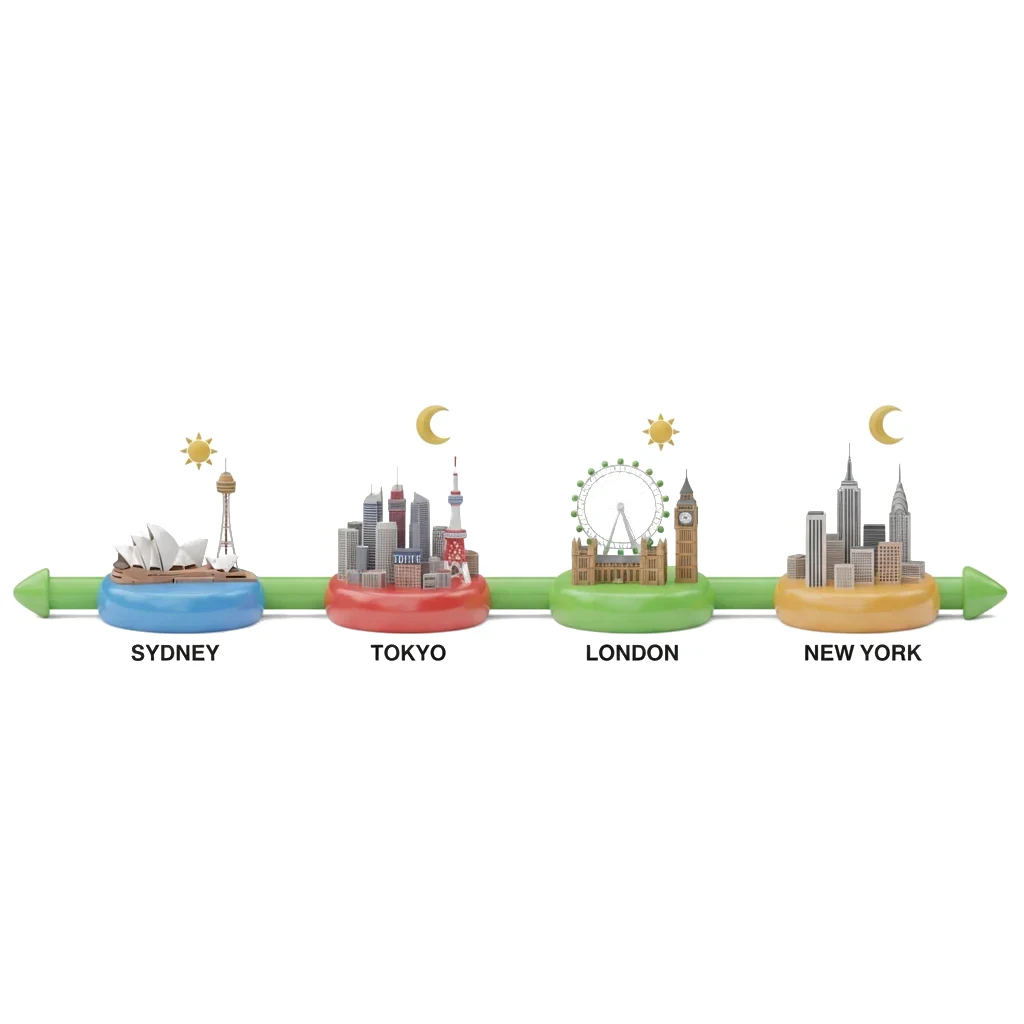
Because forex is a network of banks spread across the globe, trading follows the sun. The week opens on Sunday evening when Sydney comes online, and closes on Friday evening when New York shuts. In between, it never stops.
Traders split the day into four sessions. They overlap, and the overlaps are where the action lives. The busiest window by far is when London and New York are both open, roughly 13:00 to 17:00 GMT. Spreads tend to be tightest and price moves largest during that stretch.
Two practical warnings. These times shift by an hour when countries move on and off daylight saving, and MetaTrader 5 charts run on your broker's server time, not your local clock. Check what that server time is set to before you trust any session-based analysis.
Being open all night sounds like a gift. In practice it is a trap for beginners who feel they have to watch everything. Pick the one session that fits your actual life and let the other three happen without you.
| Session | Approx. hours (GMT) | Typically most active pairs |
|---|---|---|
| Sydney | 22:00 to 07:00 | AUD/USD, NZD/USD |
| Tokyo | 00:00 to 09:00 | USD/JPY, AUD/JPY |
| London | 08:00 to 17:00 | EUR/USD, GBP/USD |
| New York | 13:00 to 22:00 | EUR/USD, USD/CAD |

What Actually Moves the Price
Currencies move because money moves. If more capital wants to sit in euros than in dollars, the euro rises. Everything below is really just a reason for that flow to change direction.
Interest rates are the heavyweight. Money tends to drift towards currencies that pay more, so when a central bank raises rates, or even hints that it might, that currency often strengthens. This is why traders sit up for meetings of the US Federal Reserve, the European Central Bank and the Bank of Japan.
Economic data is the next lever. Inflation reports, growth figures and employment numbers all shape what traders expect central banks to do next. The US Non-Farm Payrolls release, published on the first Friday of most months, can move major pairs by 50 to 100 pips within minutes.
Risk sentiment and politics fill in the rest. When markets get nervous, money often runs towards currencies seen as safer, historically the US dollar, the Japanese yen and the Swiss franc. Elections, trade disputes and energy prices all feed the same tug of war.
Ollie's tip
You do not need all 24 hours. I trade one session, then close the laptop. Missing a move is not the same as losing money.
The Honest Part
Forex is genuinely accessible. You can open an account with a couple of hundred dollars, download MetaTrader 5 for free and place a trade within the hour. That accessibility is exactly why so many people lose money at it.
Regulated brokers in Europe and the UK are required to publish the percentage of retail accounts that lose money. Across brokers, those disclosures usually land somewhere between 65% and 85%. They are published figures, not scare tactics, and they mostly reflect oversized positions and no plan rather than bad luck.
None of that means you should stay away. It means you should learn before you risk anything that matters. Almost every broker offers a demo account with virtual money and live prices, and there is no rule anywhere saying you have to be in a hurry.
Your homework for this lesson
Open a demo account in MetaTrader 5 and place ten trades of 0.01 lots on EUR/USD. Do not try to profit. Just be able to say out loud, for each one, which currency you bought and which one you sold.
Ollie's tip
Nobody starts good at this. Give yourself a full term of practice before real money. The market will still be here.
Professor Ollie's Lesson

- Every forex trade is a swap: you buy one currency and sell another at the same moment, never one on its own.
- In EUR/USD at 1.0850, EUR is the base and USD is the quote, so one euro costs 1.0850 US dollars.
- 0.01 lots equals 1,000 units. On EUR/USD one pip is worth $0.10, so a 30 pip move is $3.00 before the spread.
- The market runs 24 hours a day, 5 days a week, and the London plus New York overlap (13:00 to 17:00 GMT) is the busiest window.
- Broker disclosures put retail losing accounts at roughly 65% to 85%, so practise on a demo before risking real capital.
Check yourself
Five quick questions on this lesson. Nothing is saved and nobody is watching.
Your platform shows GBP/USD at 1.2650. What is that number actually telling you?
Common questions
QIs forex trading good for beginners?
It is accessible but it is not easy. You can start with a small account and trade 0.01 lots where a 30 pip move is only $3.00, yet published broker data shows most retail accounts lose money. Treat your first months as study time, use a demo account, and only ever risk money you could afford to lose completely.
QHow much money do you need to start forex trading?
Many brokers accept deposits of $50 to $200, and a 0.01 lot EUR/USD position needs roughly $36 of margin at 1:30 leverage. The better question is not the minimum but the sensible amount. If losing $3.00 on a 30 pip move already makes you tense, the position is too big or the account is too small.
QWhy is the forex market open 24 hours a day?
Because there is no central exchange. Trading passes from bank to bank as each region's business day begins, from Sydney to Tokyo to London to New York, so prices run continuously from Sunday evening to Friday evening. It pauses at weekends simply because those banks are closed.
QWhat is the difference between forex trading and CFD trading?
In retail forex you are usually trading a CFD (contract for difference) already, an agreement with your broker to settle the price change in cash. You never receive actual euros or yen. The term CFD just covers a wider set of markets, including stock indices, commodities and individual shares.
How to Start Forex Trading, One Step at a Time
Next lesson →What Is a Pip in Forex, and What Is One Worth?
Risk warning. Trading forex and CFDs carries a high risk of losing money rapidly due to leverage. This lesson is educational content, not financial advice. Professor Ollie is our teaching mascot. Lessons are written and reviewed by The Trading Classroom editorial team.