
What Are the Major Currency Pairs?

The Trading Classroom
Written and reviewed by our editorial team · Updated June 2026

Major currency pairs are the seven heavily traded pairs that all include the US dollar on one side. Together they account for roughly 60% of global currency turnover. Their high trading volume usually means tighter spreads, often between 0.1 and 1.2 pips on EUR/USD, and fewer sudden price gaps.
What you'll learn
 What you'll learn
The Dollar Sits on One Side of Almost Every Trade
Here is a number that catches most new traders off guard: the US dollar is on one side of close to 90% of all forex trades. Not 90% of American trades. Close to 90% of every currency trade on the planet, including a Japanese bank dealing with a German fund.
That sounds impossible until you remember every forex trade involves two currencies. Add up the share of every currency and the total comes to 200%, not 100%. The dollar takes a huge slice of it because most oil, most commodities and a large share of international invoices are still priced in dollars.
This is the entire reason the majors exist. A major currency pair is a pair where one side is the US dollar and the other side is the currency of another large, developed economy. Every other category in forex is defined by how far it sits from that centre.
That concentration has a very practical effect on you. Because so much of the world's trading activity points at the dollar, the pairs containing it have the most orders resting in the market at any given hour of the day. That is precisely what makes them cheaper and steadier to trade than anything else on your platform.
Meet the Big Seven
Most brokers and most textbooks list seven majors. There is no official committee voting on the membership, so you will occasionally see a list of six or eight, but these seven appear on almost every one. The spreads below are typical retail ranges during normal market hours, not a promise from any particular broker.
Reading a pair is simpler than it looks. In EUR/USD, the euro is the base currency and the dollar is the quote currency. A price of 1.0850 means one euro costs 1.0850 US dollars. The currencies involved across the seven are the euro (EUR), the Japanese yen (JPY), the British pound (GBP), the Swiss franc (CHF), the Australian dollar (AUD), the Canadian dollar (CAD) and the New Zealand dollar (NZD).
The nicknames are not marketing inventions. GBP/USD is called Cable because pound and dollar quotes used to travel down a transatlantic telegraph cable laid on the seabed in the 1860s. USD/CAD is the Loonie, after the loon bird stamped on the Canadian one dollar coin. EUR/USD picked up Fiber much later, a nod to the fibre optic lines that eventually replaced all that copper.
| Pair | Nickname | Typical spread |
|---|---|---|
| EUR/USD | Fiber | 0.1 to 1.2 pips |
| USD/JPY | Gopher (or Ninja) | 0.2 to 1.4 pips |
| GBP/USD | Cable | 0.3 to 1.6 pips |
| AUD/USD | Aussie | 0.3 to 1.6 pips |
| USD/CHF | Swissy | 0.5 to 2.0 pips |
| USD/CAD | Loonie | 0.5 to 2.0 pips |
| NZD/USD | Kiwi | 0.6 to 2.2 pips |

Ollie's tip
I opened my first account and watched eight pairs at once. Busy screen, worse results. One pair teaches you more than eight.
Majors, Minors and Exotics
Take the dollar out of a pair but keep two major currencies, and you get a minor pair, also called a cross. EUR/GBP, EUR/JPY, AUD/NZD and CAD/CHF all qualify. The name is a leftover from the days when turning pounds into yen meant crossing through the dollar in two separate trades.
Pair a major currency with the currency of a smaller or emerging economy and you get an exotic. USD/TRY (Turkish lira), USD/ZAR (South African rand), USD/MXN (Mexican peso) and EUR/PLN (Polish zloty) all live here. Nothing is wrong with those economies. The question is purely how many people are trading their currency at 3am on a Tuesday.
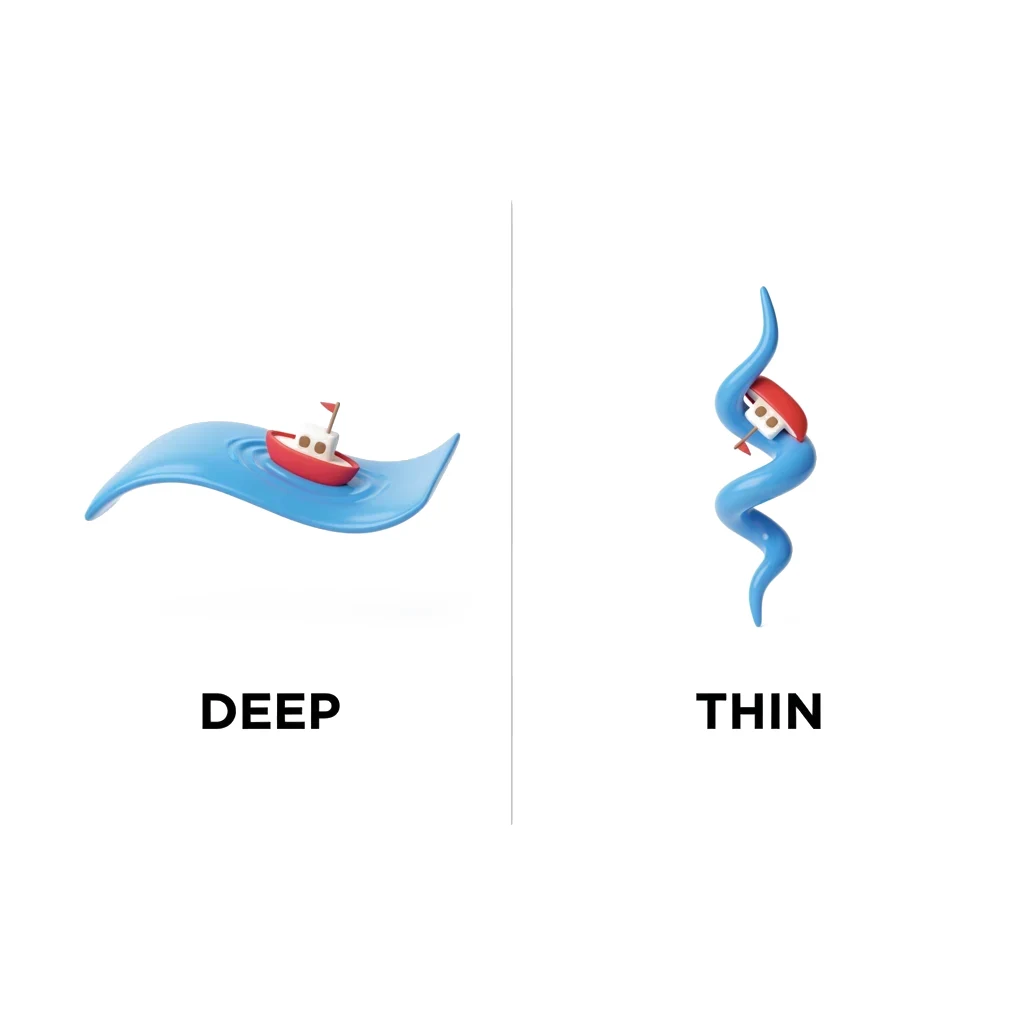
That is the real dividing line, and it has a name: liquidity. Liquidity means how many buyers and sellers are standing ready to trade at any given moment. High liquidity gives you a tighter spread, faster fills and prices that move in small, orderly steps. Low liquidity gives you the opposite, and it charges you for the privilege.
Your MetaTrader 5 platform has already sorted this out for you. Right click inside the Market Watch window, choose Symbols, and you will see your broker's folders: Forex Majors, Forex Minors, Forex Exotics. If a pair is buried three folders deep and has to be enabled before it will even show you a price, that tells you plenty about how many people trade it.
What Liquidity Actually Costs You
Your broker quotes two prices for every pair. The bid is what you can sell at, the ask is what you can buy at, and the gap between them is the spread. That gap is the first cost of every trade, and you pay it the instant you open a position.
Say EUR/USD is quoted 1.08500 bid and 1.08508 ask. The difference is 0.00008. On most pairs one pip is 0.0001 (on yen pairs it is 0.01), so that spread is 0.8 pips.
Now put a size on it. A 0.10 lot trade on EUR/USD is 10,000 euros. One pip on 10,000 units is 10,000 x 0.0001 = $1. So the spread costs you 0.8 x $1 = $0.80 the moment you click buy. Open and close that same trade 20 times in a month and the spread has quietly taken 20 x $0.80 = $16 from your account.
Some accounts advertise a near zero spread and charge a separate commission instead, commonly around $7 per standard lot for a round turn, which works out to roughly $0.70 on a 0.10 lot trade. Different packaging, similar total. The point is that on the majors this cost is small and predictable.
Break even is further away than you think
With a 0.8 pip spread on EUR/USD, price only has to move 0.8 pips your way before you are level. On a quiet exotic quoted with a 45 pip spread, it has to move 45 pips, more than fifty times further, just to get you back to zero.
Ollie's tip
If a pair is not on your broker's front page, ask yourself who else is trading it at 3am. Usually nobody is.
Why Exotics Look Tempting (and Usually Are Not)
Exotics move. A pair like USD/TRY or USD/ZAR can travel several percent in a single session while EUR/USD often moves less than 1%. On a chart, that looks like pure opportunity sitting there unclaimed.
The catch arrives in three parts. The spread is wider, so every trade starts deeper in the hole. Liquidity thins out fast around news, so your stop loss can fill at a worse price than you asked for, which is called slippage. And overnight financing (the swap your broker charges or pays for holding a position past the daily rollover) is usually much larger on exotics, because the interest rate gap between the two currencies is much larger.
There is a quieter problem too. Fewer participants means fewer analysts covering the currency, patchier economic data, and in some cases a central bank that steps into the market without warning. When price moves because of a policy decision nobody outside the country saw coming, no amount of chart reading would have saved you.
None of this makes exotics forbidden. Experienced traders use them on purpose and for good reasons. It does mean a pair that punishes small mistakes harder is a strange place to go and make your first ones.
Gaps do not care about your stop loss
Thin pairs can reopen on Sunday a long way from where they closed on Friday. A stop loss cannot protect you across a gap, because there is no price in between for it to fill at. Your position size is the only real defence.

Where a Beginner Should Actually Start
If you want one answer, it is EUR/USD. It is the most traded pair in the world, which buys you the tightest spreads available anywhere, the smallest slippage, and price that tends to move in steps rather than lurches.
There is a less obvious advantage too. Because so many people trade it, every economic release touching the euro or the dollar gets explained somewhere, in your language, within minutes. When you are still learning why price moved, that matters far more than it sounds.
USD/JPY and GBP/USD are sensible second pairs once EUR/USD feels familiar. GBP/USD typically covers a wider daily range, so the same lot size produces bigger swings in your balance. Crosses like GBP/JPY are famously volatile and are better left until you have a routine you trust. Exotics can wait longer still.
One honest caveat before you go. No pair is safe. EUR/USD is the calmest of the majors and it can still travel 100 pips in an hour after a central bank surprise. Liquidity lowers your transaction costs. It does not lower your risk. That job belongs to your position size and your stop loss, and nothing else.
Try the 30 day rule
Pick one major and trade only that pair for 30 days. You will start recognising its normal daily range, its quiet hours and how it reacts to news. That pattern recognition is worth more than watching eight charts badly.

Ollie's tip
Tight spreads are a discount on your mistakes, not protection from them. Your stop loss still does the heavy lifting.
Professor Ollie's Lesson

- All 7 majors contain the US dollar, which sits on one side of close to 90% of every forex trade placed worldwide.
- Minors (crosses) join two major currencies with no dollar involved; exotics pair a major with an emerging market currency.
- A 0.8 pip spread on a 0.10 lot EUR/USD trade costs $0.80, because one pip on 10,000 units is worth exactly $1.
- A 45 pip exotic spread means price must travel more than fifty times further than 0.8 pips before you break even.
- Start on EUR/USD for the tightest spreads (0.1 to 1.2 pips) and the widest news coverage, then add USD/JPY or GBP/USD.
Check yourself
Five quick questions on this lesson. Nothing is saved and nobody is watching.
Your broker's Market Watch window shows these four pairs. Which one belongs in the Forex Majors folder?
Common questions
QWhat are the 7 major currency pairs?
EUR/USD, USD/JPY, GBP/USD, AUD/USD, USD/CHF, USD/CAD and NZD/USD. Every one contains the US dollar paired with the currency of another large, developed economy. Some lists show six or eight because there is no official standard, but these seven are close to universal.
QWhich currency pair is best for beginners?
EUR/USD is the usual starting point. It carries the tightest spreads, often between 0.1 and 1.2 pips, the deepest liquidity of any pair, and more free analysis than anything else, so it is easier to work out why price moved. No pair removes risk, though.
QWhat is the difference between major and minor currency pairs?
A major always includes the US dollar. A minor, also called a cross, combines two major currencies without the dollar, such as EUR/GBP or AUD/NZD. Crosses are still liquid, but their spreads are typically two to four times wider than EUR/USD.
QWhy is GBP/USD called cable?
Because pound and dollar quotes were sent between London and New York through a transatlantic telegraph cable laid under the ocean in the 1860s. The wire is long gone, the nickname stuck. EUR/USD is sometimes called Fiber for the same reason, updated for fibre optics.
Risk warning. Trading forex and CFDs carries a high risk of losing money rapidly due to leverage. This lesson is educational content, not financial advice. Professor Ollie is our teaching mascot. Lessons are written and reviewed by The Trading Classroom editorial team.